Row Weeder, the strawberry escape weeder
Row Weeder, formerly Rover 1, is a small rover for annual weeds that escape the Sinbar (terbacil) programme. It straddles one strawberry row, photographs the mat under a hood, then stops to place a spinning tool on a confirmed annual target. A Stinger-only hooded cup on each head is proposed for clover, with sorrel requiring an operator override; white cockle stays hand removal. A two-head proposal, last revised 2026-11-03 (round 13); nothing has been built.
In the fleet design, Row Weeder keeps four-wheel steer and its own drive controller, with a MAVLink interface to Base. The existing simulation below retains its earlier drive model.
Watch it weed — live simulation
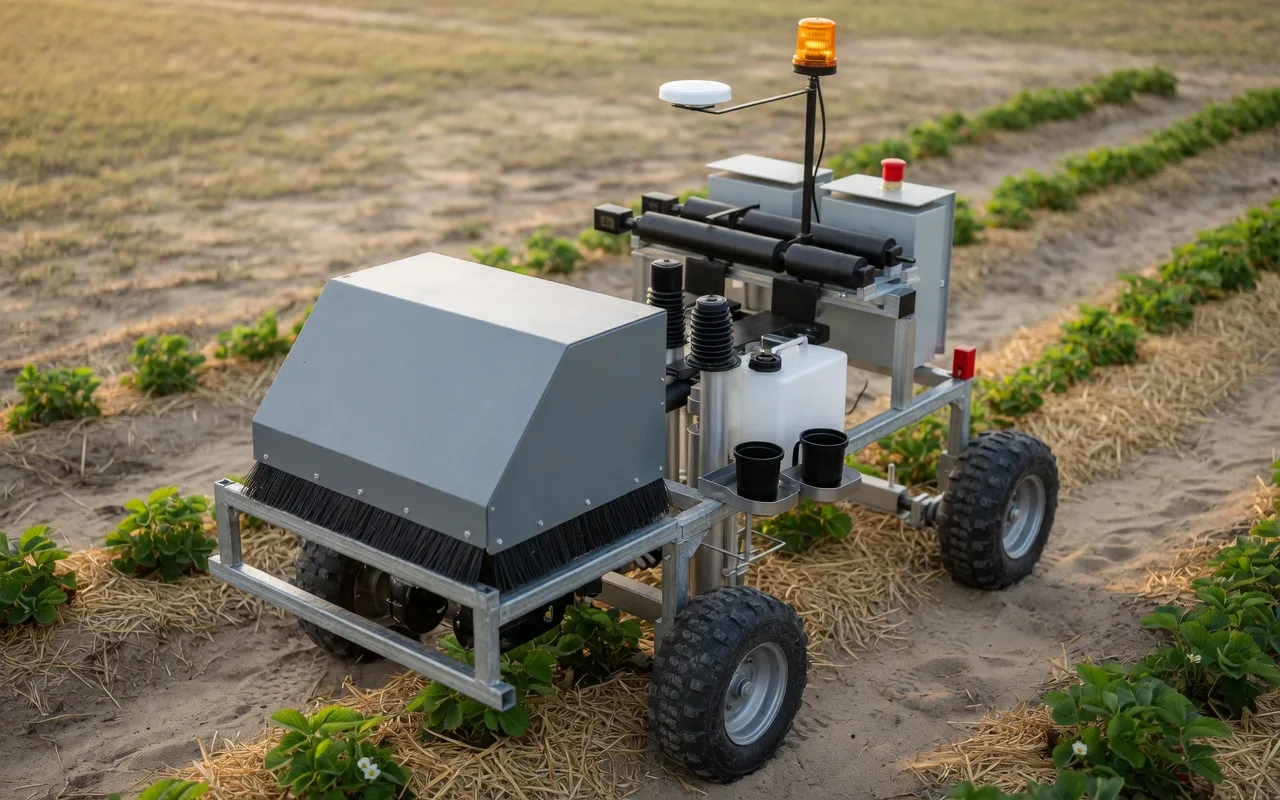
Round 12 proposal — 2026-09-28. The design adopts the pictured sloped hood, front hoop, knobby tyres and horizontal tank, with a chain reduction to restore torque margin. Round 12c passed its mesh gate (286 parts, 36 poses, 0.0000 mm³); the viewer shows it. Nothing has been built or sprayed.
Round 13 — 2026-11-03: a front axle that rocks, and a tine that finds the soil. A calculation dropped one wheel into a 50 or 100 mm hole. On the rigid frame, an ordinary 50 mm rut lifts a driven wheel clear of the ground. So the front wheels, their drives and the bumper now ride a 40 × 40 × 3 mm beam that pivots ±5° on one M20 bolt in two flanged iglidur bushes. Two 30 mm rubber stops limit it, and all four wheels keep their share of the weight. No axle layout keeps the tine’s depth or the camera’s map right on its own: they stay 14–42 mm and 20–60 mm off. So each spring foot now carries a steel flag that trips an M8 inductive sensor when the foot meets the soil, and the tine plunges 50 mm below that point. The IMU already in the compute box corrects the hood camera’s ground map for the frame’s tilt. What it found: the Z axis needs about 45 mm more travel downward to keep a full bite where the soil sits low. That change is for the next round. Front axle at its stop shows the axle at 5°. The ground isn’t modelled, so one front wheel sits in it. The new bought parts come to under $100 with the sensor cables, not yet in the budget below.
Parts
One HIWIN HGR15R-820 X rail on one beam, four blocks and two independently driven carriages. Two HGR15R-460 Y slides give ±150 mm. Two 640 mm moving columns carry the spindle and anti-wrap foot; the tip travels 350 to −50 mm. Matching two-start Tr16×8 screws correct the research’s screw/nut mismatch. Four StepperOnline XY kits and two 23HS30 brake motors drive the six axes; the Z brakes hold without power. Screw bellows, folded covers, scrapers and brushes protect the ways.
Four Jkong 48 V braked 30:1 motors now drive Redline HUCBTR 4-on-4 hubs with L44649 tapered bearings ($35.99 each) on leg-bolted BTR stub spindles ($40 each allowance). Guarded 12:18 (1.5:1) #40 chains use independently supported jackshafts, so the gearboxes carry torque only. Shaft/coupling sets add $90 per corner and chain/sprockets $80 per corner (NITRO 40A12 $7.58 + 40A18 $9.55, with chain/adapters allowance). Kenda K502 Terra Trac 16×6.50-8 chunky-lug tyres ($57.24 each) on silver steel rims ($74.95 each allowance) retain the same wheel centres. One LiTime ABS GC2 Smart pack provides 1.536 kWh; an optional second pack awaits weighing. The owned Pi 5 8 GB + AI HAT+ 2 (Hailo-10H) handles hood cameras, control and RTK; the owned Pi 5 2 GB sends the two head-camera streams over Ethernet. Two SC1148 coolers ($10 each) and two SanDisk High Endurance cards ($22 each allowance); no NVMe or fallback Hailo purchase. Software uses hailo-h10-all and H10 HEFs, not Hailo-8 HEFs.
Two outdoor Bud NBF-32326 boxes ($93 each), 400 × 300 × 160 mm, separate compute/5 V from drivers, contactors, safety relay, radio receiver, fuses and power converters. Each has an M20 membrane vent ($14.73), glands and a sun shield. The Active Cooler and HAT heatsink conduct through aluminium bridges to a 6 mm lid spreader and shielded exterior; no enclosure fan. Terminal access and heat tests remain open. Chapters 91–99 are implements and attachments, one chapter per implement; D-95 is confirmed for Row Weeder’s gantry/tool. Other implement numbers are reserved, not assigned.
Bought budget: $21,213.87, including $1,560.50 for the spray kit and a quote-only certified radio. Materials add $1,810: $23,023.87 before labour, coating, freight and tax. The project’s WEEDER-PARTS.md lists each item, alternate and unresolved fit. These are planning prices, not purchase quotes.
Third tool — the spot cup. Each Z column carries a closed-top, enclosed-side 70 mm cup with a soft soil skirt, local normally closed valve and nozzle, 110 mm behind the tine. A separate lift keeps the cup clear during spinning; shared fore-aft reach is 190 mm, so mixed-tool stops are shorter. A low white horizontal 3-gal tank class envelope (160 mm diameter × 650 mm long across the frame, $180 allowance), diaphragm pump, regulator, filter, gauge and 1 L rinse bottle supply it. Stinger only: clover control, red/sheep sorrel only with operator override, smartweed suppression. No cup treatment of white cockle, knotweed, lambsquarters, pigweed or grass. Glyphosate stays refused until the shop jug’s strawberry directions expressly allow this in-row geometry. The exact 70 mm broadcast-equivalent dose is 0.157 mL solution / 0.300 µL product; a proposed 20× carrier dilution makes a 3.136 mL shot, pending calibration and uniform-coverage tests. Required software limits cover overlapping-cell spring/year caps, one shot per window, harvest and weather lockouts, no tank mix, 12-hour REI, WPS posting and two-year shot records. The farm also keeps a 14–20 day no-cultivation lockout after each shot. The live simulation exercises the proposed spray controls; physical application remains unproven.
A lower bridge. Beam top 800 mm; retracted column extrusion 1,070 mm. The brake motors reach 1,236.7 mm and their rain caps 1,240 mm. GNSS is back at the nominal tool line, 1,250.7 mm high, with 10.7 mm margin above the conservative 15° mask requirement. Uncorrected pitch error is 43.7 mm at 2° or 109.4 mm at 5°. Beacon top is 1,036.4 mm on the compute sun shield.
Layout and interlock. Track 1,219.2 mm, wheelbase 1,200 mm, tyres 398.78 × 165.1 mm, mat clearance 298.45 mm. The 2 mm folded aluminium hood slopes from 980.4 to 650 mm at the front, above a full-width flexible brush; the side rim remains 406.4 mm. The camera footprint is unchanged. A galvanized 30 × 30 × 2 mm tube hoop carries the contact edge and provides a provisional lift/tow point; its load rating needs proof testing. Left X range −50…280 mm; right −280…50 mm. The offset columns and 83 mm bellows require 224.4 mm minimum separation; closest pose is ±112.2 mm. Only one head owns the shared centre band. The beam sits behind the columns’ fore-aft sweep; its forward adapters still need a stiffness test.
Mass and stability, estimated. One pack with spray kit: 235.78 kg empty / 248.14 kg full (3 gal solution + 1 L rinse), above the 200 kg target. Full CG (560.9, 8.8, 495.8) mm; rigid side/front/rear tip thresholds 50.5°/48.5°/52.2°. These are not operating slopes. The transverse tank bottom clears the assumed canopy by 5 mm; its centre must sit 31.1 mm higher than the old side tank, although the total CG falls by 8.1 mm after all changes. 48.09 N·m/wheel estimated continuous now exceeds wet-flat demand by 32.12% with one pack / 25.69% with two. At 1 mph the motors turn 963 rpm, below the recorded 3,000 rpm rating. Wet traction coefficient 0.4 is an assumption, with no knobby improvement credited; wet 10% grade has zero grip reserve. Keep flat-block wheel trials and the existing slip/rut triggers for reviewing tracks. Measure corner weights, slip, ruts and brake hold.
Safety. Tele Radio Tiger G2 TG-T9-12 / TG-R4-3, 915 MHz, has a certified SIL 3 / PL e stop function. Two dual-NC wired mushrooms, the radio’s two stop relays and the monitored safety edge feed both channels of a Pilz PNOZ s4. Its outputs remove drive and tool contactor power and release power from the Z and wheel brakes. Manual reset only. Machine Category 3 / PL d is DESIGN INTENT, to be verified: contactor feedback, fault analysis, braking/coast-down and radio-loss tests are missing. Radio response can add 500 ms before mechanical stopping. Stay attended.
Runtime and work rate. Spray pump power, selector time and shorter mixed-tool indexing reduce endurance and work rate; measure matching duty before claiming acres per charge. The wider interlock leaves little simultaneous work: at 0.5 escapes/m², a two-head 10-acre pass is 55.27 hours in April and 60.12 hours in July, narrowly missing the 60-hour July target. Those mechanical-only times exclude spraying. Axis speeds, weed density and duty are assumptions; turns, charging and retries are excluded.
Plant map. Build it on the first weeding pass and update it every pass. Stop, apply brakes, confirm a safe annual target and check live crop guards before cutting. Mark white cockle for hand-pulling; sorrel defaults to hand removal unless its Stinger override is deliberately recorded. RTK guides the row; camera and encoder registration place the tool.
Gate repairs. The X cover clears the tower overlap; stops now seat on the beam. Electronics boxes and battery carriers use separately named shells and lids with real mating gaps. Full mesh checks remain pending.
The four parts decisions are answered. Optional LC29H reuse still requires compatibility tests. UNVERIFIED: hub/spindle/rim interfaces, chain loads and crawl thermal duty, dynamic torque, column stiffness, coupler retention, flexible cover routing, spindle wrapping/coast, regulated power and regen, complete safety wiring, thermal/optical sealing and field crop performance. No build or safety release is claimed.